You look at a bowl of fishball noodles and think: how complicated can this be? Noodles, fishballs, sauce, soup. But the gap between a bad bowl and a good one is enormous. A bad bowl is soggy noodles in thin sauce with spongy factory balls that taste like flour. A good bowl is springy noodles coated in chilli-vinegar-lard sauce, with handmade fishballs that bounce and taste like fish. Most stalls serve the factory version.
Two styles, not one
Before anything else, you need to know that "fishball noodles" in Singapore means two different things depending on who made them.
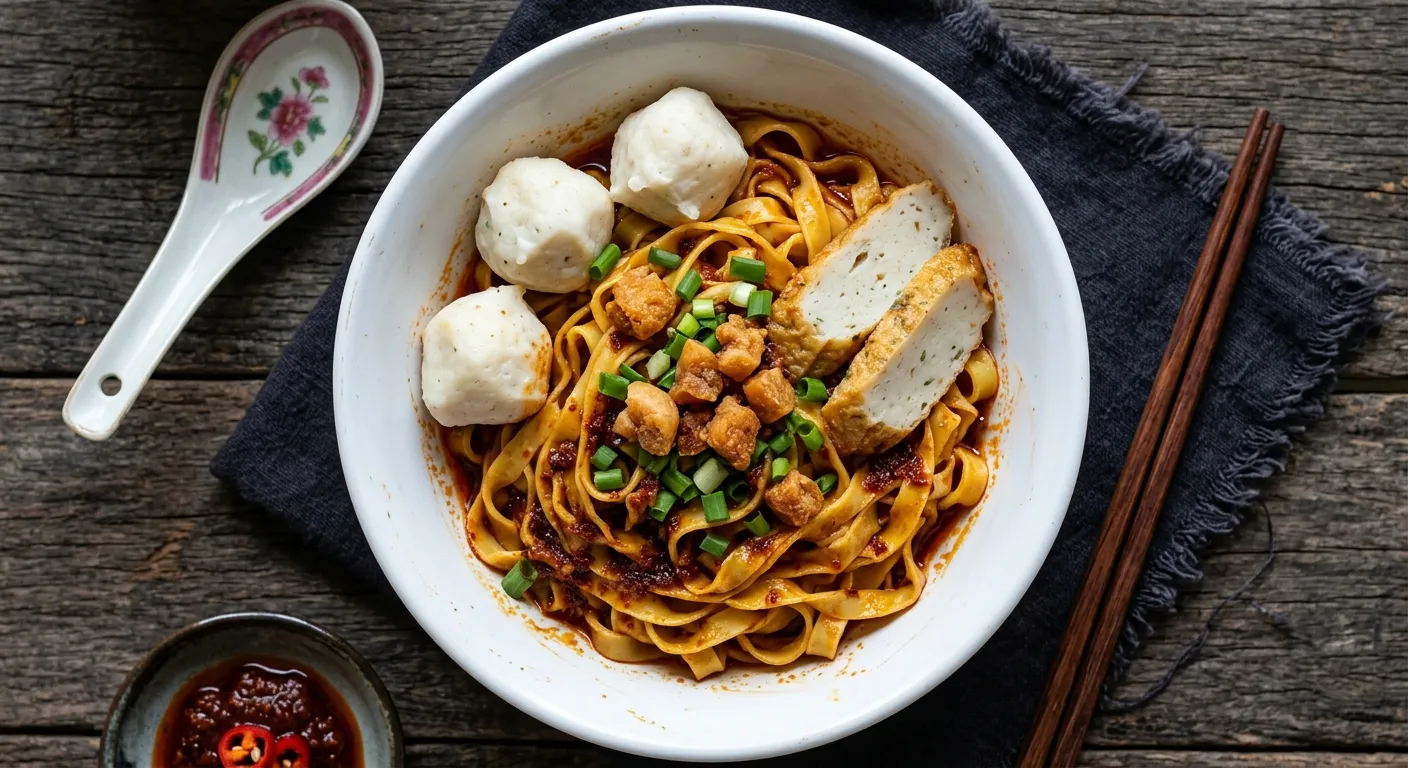
Teochew
This is the vast majority of what you will find in Singapore. When someone says "fishball noodles" without qualifying, they mean Teochew.
The fishballs are made from one of two fish (more on that below), pounded by hand into a paste and shaped into balls. No filling inside. The texture should be springy and bouncy, not soft and mushy. You get them with dry noodles tossed in a mix of chilli, vinegar, lard, and soy sauce, with a bowl of clear soup on the side.
Top Teochew Fishball Noodle Stalls
#1 Ru Ji Kitchen Holland Drive Market & Food Centre 88 #2 LiXin Teochew Fishball Noodles Kim Keat Palm Food Centre 87 #3 Song Kee Fishball Noodle Song Kee Eating House 86 #4 Ah Ter Teochew Fishball Noodles Amoy Street Food Centre 85 #5 Hock Seng Choon Fish Ball Kway Teow Mee Pasar 16@Bedok 84 #6 Meng Boon Teochew Fishball Noodle 45 Brewcoffee Kopitiam 83 #7 Yam Mee Teochew Fishball Noodles Kovan 209 Market & Food Centre 82 #8 Xin Lu Teochew Fishball Noodle Mei Ling Market & Food Centre 81Fuzhou
A Fuzhou fishball is a fish paste wrapper around a seasoned minced pork filling. You bite through the outer fish layer and hit a burst of savoury pork inside. The eating experience is nothing like a Teochew fishball. It is closer to a dumpling than a ball.
Ming Fa is the name most people know. Established in 1946, they run 13 outlets across Singapore. Ming Fa was founded by Lim Chye Kang, a Teochew man from Swatow who adopted the Fuzhou technique. The lines between traditions are not always clean.
Top Fuzhou Fishball Noodle Stalls
#9 Ming Fa Fishball Noodles Ming Fa (Upper Thomson) 80How to tell which style you are getting
Most stalls do not put "Teochew" or "Fuzhou" in their name anymore. Here is how to tell.
Look at the fishballs. Fuzhou fishballs are noticeably larger because they need room for the pork filling. They often have a visible seam or pinch mark where the wrapper was sealed. Teochew fishballs are smaller, with no seam.
Check the menu. If the signage says 福州 (Fuzhou), 肉馅 (meat filling), or 包肉 (wrapped pork), it is Fuzhou style. If it just says 鱼丸面 (fishball noodles) with no qualifier, it is almost certainly Teochew.
Or just ask. "Got filling inside?" Any hawker will understand immediately.
The heritage
Fishball noodles came to Singapore with Teochew immigrants from the Chaoshan region in Guangdong province. That is the area around Chaozhou and Shantou (which older Singaporeans still call Swatow). These immigrants arrived from the late 19th century through the early 20th century. Many settled around the Singapore River, concentrated in areas like Boat Quay and the old Ellenborough Market.
The technique came with the immigrants. Coastal Teochew communities had been pounding fish into paste for generations. In Singapore, fishball noodles became one of the foundational hawker dishes, sold first from pushcarts and later from permanent hawker stalls.
The dish is not in danger. You can get fishball noodles at hundreds of stalls. But the handmade version is disappearing. Teck Hin Fishball Noodle closed in May 2025. Hui Ming Fishball Mushroom Noodle closed in July 2025 after more than 40 years, because the sons did not want to take over. Each closure means one fewer stall that actually pounds its own fish.
Cross the Causeway to JB and the contrast is clear. Handmade fishball stalls are still common in Johor Bahru. In Singapore, most have switched to factory supply. It is cheaper, consistent, and does not require a 4am start to pound fish paste. You cannot blame the hawkers. But something real is being lost.
Two fish, not one
The fish matters more than most people realise. Two types are used for Teochew fishballs, and they produce noticeably different results.
Yellowtail (豆腐鱼 / 番薯鱼)
Called tau hoo her in Hokkien, also known as potato fish. This is the more common fish used today. Yellowtail fishballs are lighter, fluffier, and sweeter. The bounce is gentle: you bite in, it gives, then springs back softly. Most stalls that still handmake use yellowtail because it is more readily available and the flavour is approachable.
Wolf herring (西刀鱼)
Called sai toh her in Teochew. This is the traditional choice and the one old-timers will tell you is the real deal. Wolf herring fishballs are firmer, denser, and crunchier. The fish flavour is stronger and more pronounced. When people talk about a fishball that "snaps" when you bite it, they usually mean wolf herring.
Wolf herring is seasonal and increasingly expensive. Some premium stalls blend both fish: wolf herring for the bite, yellowtail for the body.
How to spot handmade vs factory
Handmade fishballs are irregular. Different sizes, rough edges, sometimes with visible strands of fish paste. They look like someone shaped them by hand, because someone did. When you bite one, it bounces. There is resistance, then spring. The flavour is clean fish.
Factory fishballs are perfect spheres. Uniform size, smooth surface, consistent colour. They are soft and yielding, with very little bounce. The flavour is muted. Factory fishballs are made from surimi (processed fish paste from multiple species), padded with starch and flour. The better factories use Itoyori (threadfin bream) surimi, which gives a reasonable texture. The worse ones are 40% fish and 60% filler.
Look at the fishballs before you order. If they are all the same size and perfectly round, you know what you are getting.
The sauce is the cook's signature
For dry fishball noodles, the sauce does most of the work. Four components, every cook with their own ratio.
Chilli. This is where stalls differentiate themselves. Good chilli has depth: dried shrimp, garlic, shallots, sometimes belacan pounded in. Bad chilli is just ground chillies and oil, all heat and no flavour.
Vinegar. Cuts through the richness of the lard and balances the chilli. Too much and the bowl turns sour. Too little and it feels heavy.
Lard. Rendered pork lard and the fried pork lard bits (zhu you zha / 猪油渣). The lard adds fragrance, the crispy bits add crunch. A bowl without them is incomplete. Some stalls have switched to vegetable oil. It is not the same.
Soy sauce. Usually a blend of dark and light. Ties everything together. Should support, not dominate.
Every stall has its own ratio. That is why you can eat fishball noodles at ten stalls and get ten different experiences from the same dish.
The noodle choice
You pick your noodle when you order. The stall does not choose for you.
Mee pok (薄面) is the default. Flat, wide egg noodles. The flat surface holds more sauce per strand. Should be cooked al dente: firm, with a slight chew. If the noodles clump together, the cook did not toss them fast enough.
Mee kia (幼面) is the thinner option. Round egg noodles. Lighter mouthfeel, less sauce per strand. Some regulars prefer it because it lets the fishball flavour come through more.
Kway teow (粿条) is flat rice noodles. Silkier and more delicate than mee pok. A few stalls (like Hock Seng Choon at Bedok South) default to kway teow, which is unusual.
Other options exist at some stalls: bee hoon (rice vermicelli), you mian (yellow alkaline noodles), bee tai mak (short slippery rice noodles). Mee pok is the safe first order. Branch out after that.
Dry vs soup
Dry (tah, 干) means the noodles are blanched, drained, and tossed in the sauce mix. Soup comes on the side in a separate bowl with the fishballs. This is the more popular order and what most stalls are known for. The sauce has to be right. The noodle texture has to be right. There is nowhere to hide.
Soup (terng, 汤) means the noodles sit in a clear pork-bone or fish-based broth. Lighter and more comforting. A good soup version has a broth with real body and sweetness from hours of simmering.
If you are trying a stall for the first time, order dry. That is what most stalls optimise for.
The Teochew fishball noodle family
Fishball noodles do not exist in isolation. There is a family of related items from the same Teochew tradition, and you will often find them at the same stall.
Fish dumplings (her kiao / 鱼饺). Fish paste pressed thin and folded around a filling of minced pork and ti poh (dried sole fish, 地脯). The ti poh adds a savoury depth you do not get in a regular fishball. Her kiao are Teochew, not a separate tradition. Song Kee, established in 1966, is the most famous specialist. Most fishball noodle stalls offer her kiao as an add-on.
Fried fishballs. Almost every stall serves fishballs boiled or blanched. Meng Boon on Sims Drive is the only stall in Singapore that fries theirs. Golden crust outside, bouncy fish inside. Same Teochew tradition, same handmade fishballs, different technique.
Bak chor mee crossover. Many fishball noodle stalls also serve bak chor mee (minced pork noodles). The noodle base and sauce are the same. The toppings change: fish products for fishball noodles, pork for bak chor mee. Same kitchen, same setup. Offering both doubles the menu from one station. If a stall does one well, they usually do the other well too.
Five dimensions, not one star rating
A Google review that says "nice fishball noodles, 4 stars" could mean anything. Were the fishballs handmade? Was the sauce balanced or just spicy? Were the noodles al dente or overcooked?
We score fishball noodles across five dimensions:
Texture (bouncy, springy, QQ), fish flavour intensity, handmade vs machine-made. Irregular shape is the sign of handmade. Should bounce, not crumble.
Al dente is the benchmark. Mee pok should be flat and firm, not soggy. Kway teow should be silky. Overcooking is the most common mistake.
The cook's signature. Balance of chilli, vinegar, oil or lard, soy sauce. Chilli should have depth from dried shrimp, not just heat. For soup orders, the broth should taste clean and sweet.
Fish dumplings, fish cake, meatballs, minced pork, braised mushrooms, fried lard. Freshness and generosity. Some stalls give you four fishballs, some give you six.
Price vs portion, number of fishballs, overall satisfaction. A $3.50 bowl with four bouncy handmade fishballs is excellent value. A $6 bowl with two factory balls is not.
Fishball quality and sauce share the top weight at 25% each. The fishball is the dish. The sauce is the cook. Noodle texture at 20% matters more than people think: overcooked noodles ruin an otherwise good bowl. Toppings (15%) and value (15%) round it out.
Why your Google review might be wrong
- "The fishballs were too bouncy." That is the point. Bouncy means the fish paste was properly pounded and the protein gel formed correctly. If you want soft fishballs, buy the frozen ones from NTUC. Bouncy is quality.
- "Not enough fishballs." At $3.50 to $5, you are getting four to six handmade fishballs that took hours to prepare. Each ball is pure fish, no filler. If you want more, order the larger size.
- "Too vinegary." Vinegar is a core component of the dry sauce. It cuts through the lard and chilli. If you do not like vinegar, order soup instead of dry. Do not dock a stall for making the dish correctly.
- "Same as any other fishball noodle stall." If you cannot taste the difference between handmade yellowtail fishballs and factory fishballs, or between a chilli with dried shrimp depth and one that is just ground chillies, the problem is not the stall.
Frequently asked questions
What is the difference between Teochew and Fuzhou fishball noodles?
Teochew fishballs are solid balls of pounded fish paste with no filling. Fuzhou fishballs have a seasoned minced pork filling inside a fish paste wrapper. The vast majority of fishball noodle stalls in Singapore serve the Teochew style. Ming Fa (est. 1946) is the best-known Fuzhou-style chain.
What fish is used in Singapore fishballs?
Two main fish: yellowtail (豆腐鱼, tau hoo her in Hokkien) produces lighter, fluffier fishballs. Wolf herring (西刀鱼, sai toh her in Teochew) produces firmer, denser fishballs with a stronger fish flavour. Some stalls blend both. Factory fishballs use surimi, processed fish paste often padded with starch.
How can I tell if fishballs are handmade?
Handmade fishballs are irregularly shaped with rough edges and slightly different sizes. Factory fishballs are perfectly round and smooth. Handmade ones bounce when dropped and have a springy, QQ texture. If every ball in the bowl looks identical, they are machine-made.
Should I order dry or soup?
Dry (tah) is the more popular order. The noodles are tossed in chilli, vinegar, and lard sauce with soup on the side. Soup (terng) has the noodles in a clear broth. Dry tests the sauce, soup tests the broth. If it is your first time, order dry.
What are fish dumplings (her kiao)?
Her kiao (鱼饺) are a Teochew product: fish paste pressed thin and folded around a filling of minced pork and ti poh (dried sole fish). They are part of the same tradition as fishball noodles, not a separate style. Song Kee (est. 1966) is the most famous specialist.
What is the difference between mee pok and mee kia?
Mee pok is flat and wide, similar to fettuccine. Mee kia is thin and round, similar to angel hair. Both are egg noodles. Mee pok is the more popular choice because the wider surface holds more sauce. You choose your noodle type when ordering.
Ready to eat?
See how Singapore's best fishball noodle stalls score across all five dimensions.
View Rankings →